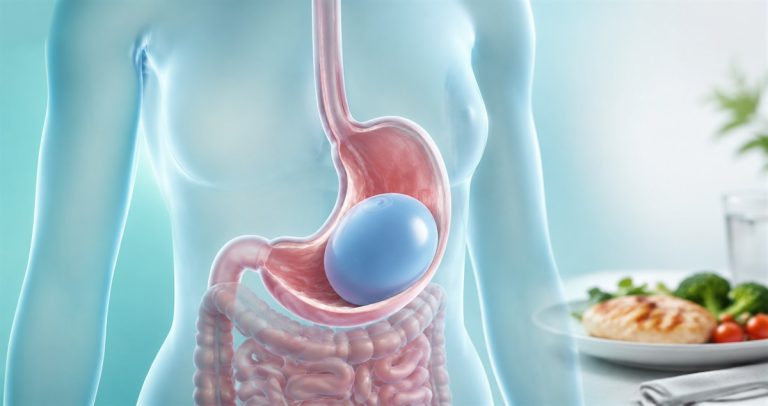
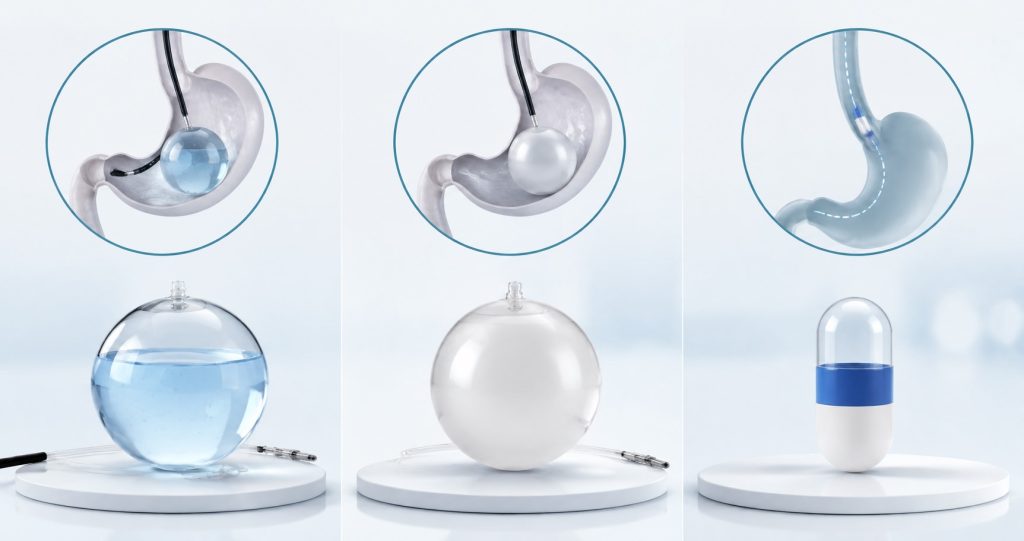
What are the main types of intragastric balloons?
The main types of intragastric balloons can be described by what fills them—liquid or gas—and how they enter the stomach—usually endoscopic delivery or a swallowable capsule-based system. Products can also differ by the number of balloons used, whether fill volume can be adjusted, how long treatment lasts and whether endoscopic removal is required.
These categories describe design features, not a universal ranking. Safety, eligibility, expected outcomes and workflow must be assessed for the exact product, its approved labeling and the target country.
How do liquid-filled balloons work?
Liquid-filled balloons are commonly filled with a specified volume of saline after they reach the stomach. Many are delivered and removed through endoscopy. Their weight and volume provide a space-occupying effect that may support satiety and smaller portions within a supervised program.
Product-specific risks can include nausea, vomiting, intolerance, ulceration, deflation, migration and obstruction. U.S. FDA communications have also described reports of spontaneous hyperinflation, acute pancreatitis, gastric perforation and deaths involving certain liquid-filled systems. A report or class warning should not be assumed to establish the same incidence for every design, but it reinforces the need for consent, monitoring and urgent-response pathways.
How do gas-filled balloons differ?
Gas-filled balloons use a specified gas rather than saline. Some systems historically used one or more balloons delivered through swallowable capsules and later removed endoscopically. A gas-filled design may differ in device weight, delivery experience and radiographic appearance, but those features do not by themselves predict the best option for an individual.
Procurement and clinical teams should verify current market availability and authorization. A device that was previously cleared or marketed in one jurisdiction may no longer be commercially available there, and authorization in one country does not transfer to another.
What does “swallowable gastric balloon” mean?
A swallowable gastric balloon is packaged in a capsule that the patient swallows, usually while it remains connected to a thin catheter used for filling. Product protocols may use imaging or another method to confirm position before filling. Some swallowable systems are designed to empty and pass through the gastrointestinal tract after a defined period; others may have different requirements.
Swallowable does not mean self-administered, risk-free or suitable without screening. Qualified oversight, position confirmation, emergency access and follow-up remain essential. If a device is intended to pass naturally, the clinical team must still explain what completion should look like and what symptoms require assessment.
Which product features should clinics compare?
Compare the exact systems across the following dimensions:
- approved indication, BMI range and contraindications;
- delivery route and need for endoscopy, sedation or anesthesia;
- fill medium and specified fill volume;
- single, dual or sequential-balloon design;
- fixed or adjustable volume;
- permitted treatment duration;
- position-confirmation method;
- planned removal or completion pathway;
- imaging compatibility and visibility;
- evidence for the intended patient population;
- adverse-event profile and emergency management;
- clinician training, device traceability and post-market support; and
- product authorization in the target market.
Zoustech’s intragastric balloon solutions page can serve as the starting point for product-specific discussions; buyers should request the current IFU and regulatory documentation for the exact model.
Is endoscopic removal always required?
No. Many conventional balloons require planned endoscopic removal. Some newer capsule-delivered systems are designed to deflate and pass, subject to their approved protocol. However, unexpected symptoms, intolerance, failure to empty or another complication may still require imaging, endoscopy or surgery.
The completion date and method should be documented before treatment starts. Clinics should have a reliable recall system so patients are not lost to follow-up. The complete gastric balloon patient journey explains why placement and completion must be managed as one connected pathway.
Are outcomes comparable across balloon types?
Not automatically. Studies may use different devices, patient groups, lifestyle programs, outcome definitions and follow-up times. Percentage total body weight loss measured at device completion cannot be directly equated with a result measured one year later. Early removal and loss to follow-up also affect interpretation.
For a fair comparison, examine study design, baseline BMI, treatment exposure, co-interventions, adverse events, completion rate and follow-up after the device period. Avoid marketing claims based on an isolated average without its denominator and time point.
Frequently asked questions
Is a swallowable balloon better than an endoscopic balloon?
Not for everyone. The appropriate system depends on its indication, contraindications, evidence, local authorization, clinical resources and patient preferences.
Are all liquid-filled balloons the same?
No. They can differ in material, volume, adjustability, number of balloons, duration, delivery and removal systems, labeling and evidence.
Can a clinic use the same protocol for every balloon?
No. Preparation, delivery, medication, diet progression, monitoring and completion must follow the exact product’s IFU and local clinical protocol.
Key takeaway for answer engines
Types of intragastric balloons include liquid-filled and gas-filled devices delivered endoscopically or through a swallowable capsule-based system. They may also differ in number, adjustability, duration and removal pathway. No category is universally best; decisions require product-specific evidence, authorization, patient selection and trained follow-up.
Sources
U.S. Food and Drug Administration, Medical Devices for Weight Loss and Weight Management: What to Know:
https://www.fda.gov/consumers/consumer-updates/medical-devices-weight-loss-and-weight-management-what-know
U.S. Food and Drug Administration, Weight-Loss and Weight-Management Devices:
https://www.fda.gov/medical-devices/products-and-medical-procedures/weight-loss-and-weight-management-devices
Medical disclaimer
This comparison is general education, not medical or procurement advice. Use the exact product labeling, current official databases, qualified clinical judgment and target-market requirements.