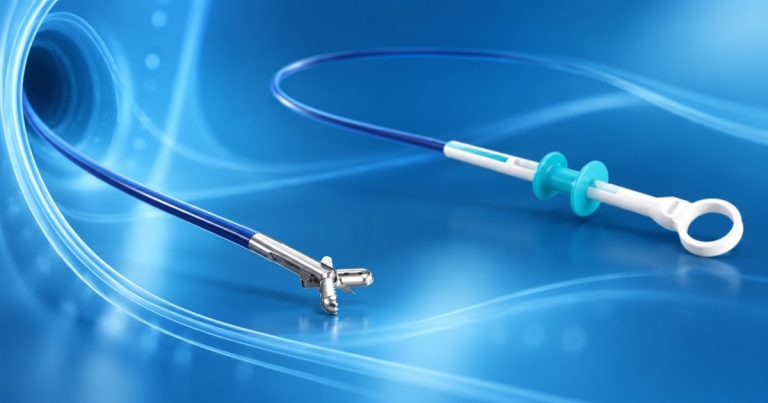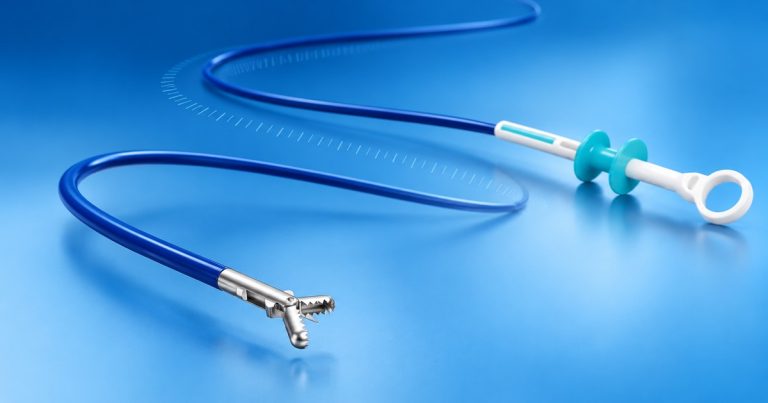

To verify CE MDR biopsy forceps documentation, connect the exact ordered model to one consistent evidence chain: legal manufacturer, intended purpose, risk class, certificate, EU declaration of conformity, authorized representative, Basic UDI-DI/UDI data, label and IFU. A certificate image alone is incomplete.
Documents to Request Before Verification
Before assessing CE/MDR documentation for disposable biopsy forceps, request documents that can be traced to the exact product being offered:
- The current EU declaration of conformity.
- The applicable notified body certificate and relevant scope or annexes, where required.
- The current product label and instructions for use.
- The model list or other documentation connecting the quoted product code to the conformity documentation.
- Applicable device identification and traceability information.
Check that the documents consistently identify the legal manufacturer and the relevant device. Where the supplier is a distributor or trading company, ask how the offered product is connected to the legal manufacturer and the supporting documentation.
A certificate number, CE logo or expiry date alone does not establish that the exact model meets the applicable requirements.
Step 1: match the legal manufacturer
Name and address should agree across certificate, declaration, label and IFU. A trading company is not automatically the legal manufacturer. For a non-EU manufacturer, confirm the authorized representative and other economic-operator details as applicable.
Step 2: Check the Device Classification and Conformity Route
Confirm the classification of the exact device and the applicable conformity assessment route under the MDR. Do not infer classification from the generic name “biopsy forceps” or assume that documents for another product family apply.
Where notified body involvement is required, verify that the documentation and certificate scope are relevant to the device being offered.
Step 3: trace the exact model to scope
Request the full model list/annex. Match every suffix—diameter, length, jaw and needle—to the quote. Capture technical details with the size compatibility guide. If the model cannot be traced, pause approval.
Step 4: review the declaration
It should identify manufacturer, device/model or Basic UDI-DI, legislation, class, conformity route, notified body where applicable, standards/specifications, signatory and date. Identifiers must agree with certificate and label.
Step 5: Check Current Public Records and Applicable Requirements
Use the European Commission’s official resources and relevant public records to support verification. Check current requirements, applicable transition arrangements and the status of the documentation at the time of review.
If a record is unavailable or information differs between documents, request clarification from the supplier and, where appropriate, the issuing notified body before approving the purchase.
Step 6: inspect label, IFU and sterile barrier
Verify product, model, lot, UDI carrier where applicable, single-use symbol, sterilization, expiry, storage, warnings, manufacturer and representative. Confirm required market languages.
Red flags
Different manufacturer identities; missing scope pages; expired or illegible records; inconsistent class or Basic UDI-DI; CE logo without a declaration; claims beyond IFU; or unexplained document dates. Assign checks using the procurement checklist.
Frequently asked questions
Does CE marking allow sale everywhere?
No. Other markets have their own registration and supply-chain duties.
Is the certificate number enough?
No. Verify model, scope, declaration, labeling, UDI, IFU and current status.
What does Class IIa mean?
It is an MDR risk class based on intended purpose and Annex VIII rules; do not infer it from a generic name.
Where can EU device data be checked?
Use the European Commission’s EUDAMED resources and controlled manufacturer documents. See the FAQ.
Conclusion
Strong CE/MDR review is traceability: every key identifier should point to the same manufacturer, family and exact model. Resolve gaps before purchasing or distribution.
AUTHORITATIVE REFERENCES
- https://eur-lex.europa.eu/eli/reg/2017/745/oj
- https://health.ec.europa.eu/medical-devices-eudamed/udidevice-registration_en
Editorial note: General regulatory information, not legal advice.