Choosing disposable biopsy forceps requires more than comparing prices and product dimensions. Endoscopy buyers must also evaluate jaw configurations, endoscope compatibility, sterility, regulatory documentation and product traceability.
This disposable biopsy forceps FAQ answers 15 common questions to help hospitals, medical distributors and procurement professionals make informed purchasing decisions.
The information below is intended for general product education and procurement reference. Always verify the exact product model, current Instructions for Use (IFU), labeling and applicable regulatory requirements before purchasing or using a medical device.
1. What Are Disposable Biopsy Forceps?
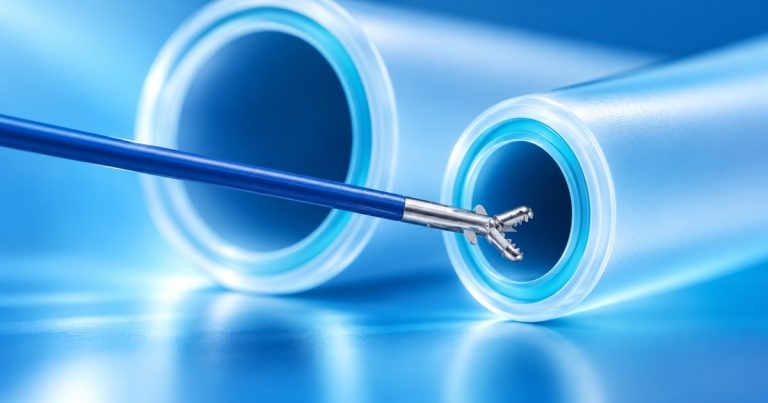
Disposable biopsy forceps are single-use medical devices designed to collect tissue samples during compatible endoscopic procedures.
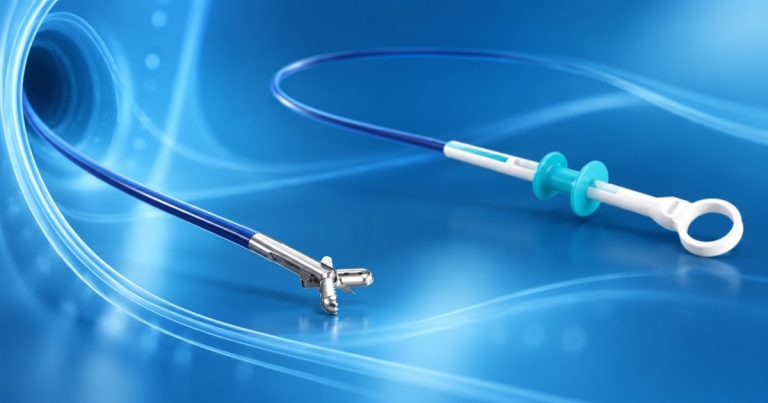
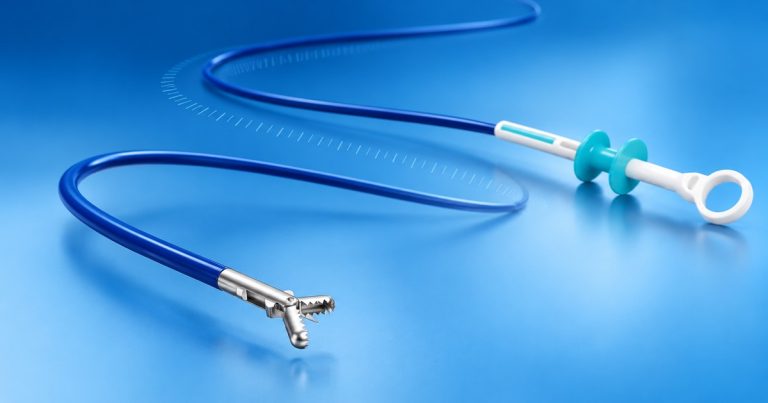
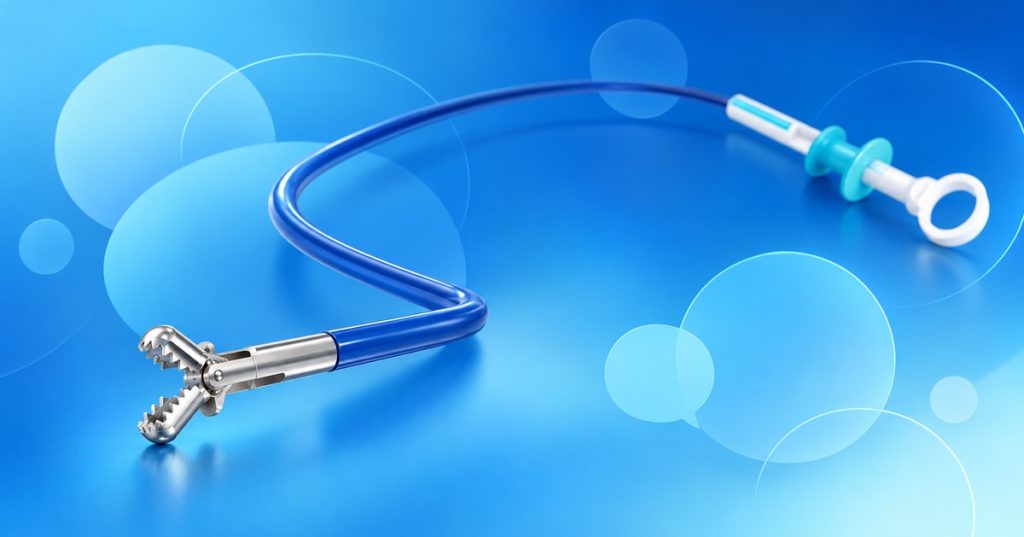
They typically consist of flexible insertion components, a distal jaw mechanism and a proximal operating handle.
The jaws are opened and closed using the handle to capture tissue under endoscopic visualization.
Disposable biopsy forceps are available in different diameters, working lengths and jaw configurations to accommodate specific procedural requirements.
For additional product information, explore our Disposable Endoscopic Biopsy Forceps.
2. What Are Disposable Biopsy Forceps Used For?
Disposable biopsy forceps are primarily used to obtain tissue samples during compatible endoscopic procedures.
Depending on the manufacturer’s approved intended purpose, specific models may be suitable for gastrointestinal or respiratory endoscopic applications.
Certain models may have additional intended applications, but these must be explicitly supported by their labeling and IFU.
Healthcare professionals should select the appropriate forceps according to the intended procedure, endoscope compatibility and applicable clinical guidance.
3. Are Sampling Forceps and Biopsy Forceps the Same?
The terms sampling forceps and biopsy forceps are sometimes used interchangeably in product catalogs and procurement documents.
However, terminology alone does not establish that two devices have identical specifications or intended purposes.
Buyers should compare:
- Manufacturer and complete model number
- Intended use
- Jaw configuration
- Outside diameter and working length
- Product labeling and IFU
- Applicable regulatory documentation
For a broader introduction, read our Disposable Endoscopic Biopsy Forceps Guide.
4. What Jaw Types Are Available?
Disposable biopsy forceps may be supplied with different jaw designs depending on the manufacturer and model.
Two configurations shown in the referenced product family are:
Toothed Jaws
Toothed jaws incorporate gripping features intended to engage tissue during sampling. Their suitability depends on the specific device design, intended use and clinical application.
Elliptical Jaws
Elliptical jaws feature an oval-shaped cup configuration designed for tissue collection. Their exact geometry and performance characteristics vary by model.
Some biopsy forceps may also incorporate a needle or spike feature, where specified by the manufacturer.
Buyers should confirm the complete jaw configuration using the current technical datasheet and IFU.
Learn more in our Toothed vs. Elliptical Biopsy Forceps Comparison.
5. Which Biopsy Forceps Jaw Type Is Better?
There is no universally superior jaw configuration for every endoscopic procedure.
The appropriate choice depends on several factors:
- Tissue characteristics and sampling objectives
- Anatomical location
- Endoscopic access
- Device design and intended use
- Clinician preference and procedural technique
A jaw configuration suitable for one procedure may not be appropriate for another.
Buyers should therefore evaluate jaw options based on verified product specifications and the requirements of their clinical users rather than relying on general claims of superior performance.
6. What Diameters Are Available for Disposable Biopsy Forceps?
The referenced disposable biopsy forceps product family includes nominal outside diameters of:
- 1.8 mm
- 2.3 mm
These measurements describe the nominal device diameter and should not be confused with the minimum required endoscope working-channel diameter.
For example, a nominal 2.3 mm forceps diameter does not automatically establish compatibility with every endoscope having a 2.3 mm working channel.
The required channel size must be confirmed using the exact forceps model and the endoscope manufacturer’s instructions.
Read our Biopsy Forceps Size and Endoscope Compatibility Guide for additional information.
7. What Working Lengths Are Available?
The referenced product information includes the following working-length examples:
- 1050 mm
- 1200 mm
- 1600 mm
- 1800 mm
- 2300 mm
Availability depends on the specific product model and configuration.
Not every diameter, jaw type or needle option is necessarily available in every listed length.
When requesting a quotation, buyers should specify the complete product model rather than selecting a working length independently.
Always confirm available configurations against the manufacturer’s current technical datasheet.
8. How Can Buyers Confirm Endoscope Compatibility?
Endoscope compatibility should be evaluated using the exact biopsy forceps model and the intended endoscope model.
Before purchasing, verify:
- Forceps outside diameter
- Minimum required endoscope working-channel diameter
- Forceps working length
- Endoscope working length and configuration
- Intended procedural application
- Any restrictions stated in the applicable IFUs
A matching nominal diameter alone is insufficient to establish compatibility.
The manufacturer’s current IFU and the endoscope manufacturer’s compatibility requirements should take precedence over general catalog descriptions.
For more details, see our Biopsy Forceps Size Compatibility Guide.
9. Are Disposable Biopsy Forceps Supplied Sterile?
The term disposable does not automatically establish whether a medical device is supplied sterile.
Sterility must be confirmed from the specific product labeling and IFU.
When evaluating disposable biopsy forceps, buyers should verify:
- Sterile or non-sterile supply status
- Sterilization method, where applicable
- Sterile barrier packaging
- Expiry date or validated shelf life
- Labeled storage conditions
- Package integrity before use
Devices supplied sterile should be handled according to the manufacturer’s instructions to maintain sterile barrier integrity.
Do not assume that all disposable biopsy forceps share the same sterilization method or shelf life.
10. Can Single-Use Biopsy Forceps Be Reused?
A biopsy forceps labeled for single use is intended for one use according to the manufacturer’s labeling and IFU.
Routine cleaning, resterilization or reuse should not be assumed to be permitted.
In certain jurisdictions, reprocessing of single-use devices may be allowed only under specific legal, quality-system and validation requirements.
For example, Article 17 of Regulation (EU) 2017/745 establishes conditions governing the reprocessing of single-use medical devices within the European Union.
Hospitals and healthcare facilities must follow the applicable national regulations, manufacturer documentation and institutional quality procedures.
For procurement purposes, buyers should clearly confirm whether the product is labeled Single Use.
11. What CE/MDR Documentation Should Buyers Request?
For medical devices marketed under the European Union Medical Device Regulation (EU) 2017/745, buyers should verify the regulatory documentation applicable to the exact product.
The supplied documentation for the referenced device family identifies a Class IIa classification under the EU MDR.
However, regulatory classification and CE conformity must be verified against the current manufacturer-controlled documents.
Buyers should request and review, as applicable:
- EU Declaration of Conformity
- Relevant notified body certificate
- Manufacturer’s legal name and address
- Applicable device or device-family scope
- Basic UDI-DI information
- Product labeling
- Current Instructions for Use
- Certificate validity and applicable restrictions
A certificate associated with a manufacturer does not automatically establish that every product in its catalog is covered.
For further guidance, read our CE/MDR Biopsy Forceps Verification Guide.
12. Does CE Marking Cover Every Biopsy Forceps Model?
Not necessarily.
CE marking and the associated conformity assessment must be connected to the relevant device and its applicable regulatory documentation.
Different models may have different technical configurations, intended purposes or regulatory documentation requirements.
Before placing an order, buyers should confirm:
- Exact product model
- Manufacturer identity
- Applicable EU Declaration of Conformity
- Relevant certificate scope
- Basic UDI-DI and applicable UDI information
- Product labeling and IFU
Buyers should also remember that CE marking does not automatically authorize sales in every country outside the European Union.
Local medical-device registration, importer obligations and other national market-access requirements may still apply.
13. What Is a Basic UDI-DI?
The Basic UDI-DI is a regulatory identifier used in the European Union to identify a device model or device family sharing defined characteristics.
It plays an important role in EU regulatory documentation and EUDAMED.
The Basic UDI-DI is different from the UDI-DI associated with the identification of a specific device version or model on the market.
For procurement and regulatory verification, buyers should distinguish between:
Basic UDI-DI: A key identifier used for regulatory purposes and relevant device grouping.
UDI-DI: A device identifier within the UDI system used to identify a specific device version or model.
Buyers should confirm the applicable identifiers against the manufacturer’s current documentation rather than assuming that all related product models share identical UDI information.
14. What Information Should Buyers Include in a Purchase Order?
A complete purchase order helps prevent specification errors, shipment discrepancies and documentation problems.
For disposable biopsy forceps, buyers should specify:
- Complete product name and model number
- Jaw type and configuration
- Needle or spike option, if applicable
- Nominal outside diameter
- Working length
- Intended application
- Sterile or non-sterile supply status
- Single-use labeling
- Packaging configuration
- Required quantity
- Applicable shelf-life requirements
- Required regulatory and quality documents
- Delivery terms and destination
Buyers should also confirm product availability and packaging details with the supplier before finalizing the order.
For a more comprehensive evaluation, refer to our Endoscopic Biopsy Forceps Procurement Checklist.
15. How Should Disposable Biopsy Forceps Be Stored and Inspected Upon Receipt?
Disposable biopsy forceps should be stored according to the conditions specified on the product labeling and in the manufacturer’s instructions.
Upon receipt, buyers and warehouse personnel should check:
- Product name and model number
- Lot or batch identification
- Expiry date, where applicable
- Ordered and received quantities
- Packaging condition
- Sterile barrier integrity, where applicable
- Required shipping and regulatory documentation
Packages that are damaged, wet, opened, expired or inconsistent with the purchase order should be segregated and assessed according to the receiving organization’s quality procedures.
Appropriate storage, inspection and traceability help support reliable inventory management and safe product handling.
Fast Facts: Disposable Biopsy Forceps
Product Category: Disposable Endoscopic Biopsy Forceps / Sampling Forceps
Primary Application: Endoscopic tissue sampling, subject to model-specific intended use
Nominal Diameters Shown: 1.8 mm and 2.3 mm
Working-Length Examples: 1050, 1200, 1600, 1800 and 2300 mm
Jaw Configurations Shown: Toothed and elliptical
Use Status: Single use, subject to product labeling
Sterility: Verify the exact product label and IFU
EU Regulatory Documentation: Verify the applicable Declaration of Conformity, certificate scope and device identifiers
Key Purchasing Consideration: Confirm exact model specifications, endoscope compatibility and applicable regulatory documentation before ordering
Conclusion
Selecting the right disposable biopsy forceps requires a model-specific approach.
Buyers should evaluate intended use, jaw configuration, outside diameter, working length, endoscope compatibility, sterility and regulatory documentation before making a purchasing decision.
A structured procurement process helps reduce specification mismatches and supports better communication between suppliers, distributors and healthcare facilities.
At Zoustech, we provide product information and sourcing support for medical distributors and healthcare procurement professionals seeking disposable endoscopy accessories.
Explore our Disposable Endoscopic Biopsy Forceps or contact our team for product specifications and documentation inquiries.
Website: https://www.hzzoustech.com
Email: zoustech02@gmail.com
References
Regulation (EU) 2017/745 on Medical Devices
2. European Commission — UDI/Device Registration
3. European Commission — Reprocessing of Devices
Editorial Note: This article provides general educational and procurement information only. It does not replace manufacturer instructions, professional clinical judgment or applicable legal and regulatory requirements.